Neural AI
Decoding Hand and Arm Kinematics for Online Invasive BCI
Patient-specific causal decoding of intracortical activity into 32 arm-and-hand posture coordinates, evaluated offline and in a 100 Hz artificial-stream test for future online control.
- Problem
- Reconstruct coordinated upper-limb posture from invasive neural recordings while respecting causal inputs and the computation budget of an online decoder.
- Approach
- Compared regularized linear, Kalman-family, GRU, LFADS-lite and causal Transformer decoders. Tested neural and kinematic PCA, object context and two elapsed-time representations.
- My contribution
- Designed the decoder benchmark, training/validation/test splits, representation comparisons and evaluation pipeline; implemented held-out MuJoCo replay and causal output filtering.
- Result / evaluation
- On new repetitions of known movements, the validation-selected, object-conditioned GRU reached R² = 0.832 with trial-normalized timing; fixed-onset LFADS-lite reached R² = 0.723. Accuracy dropped on unseen gestures and recording days. Artificial-stream node tests ran at 100 Hz; they exclude acquisition, transport and actuator latency.
- Why it matters
- Identifies a candidate for online testing and makes the tradeoffs between accuracy, timing assumptions, generalization and output smoothness explicit. Live closed-loop robotic control was not established by these experiments.
- Technical stack
- Causal temporal models · PCA · MuJoCo · Model evaluation
Movement replay
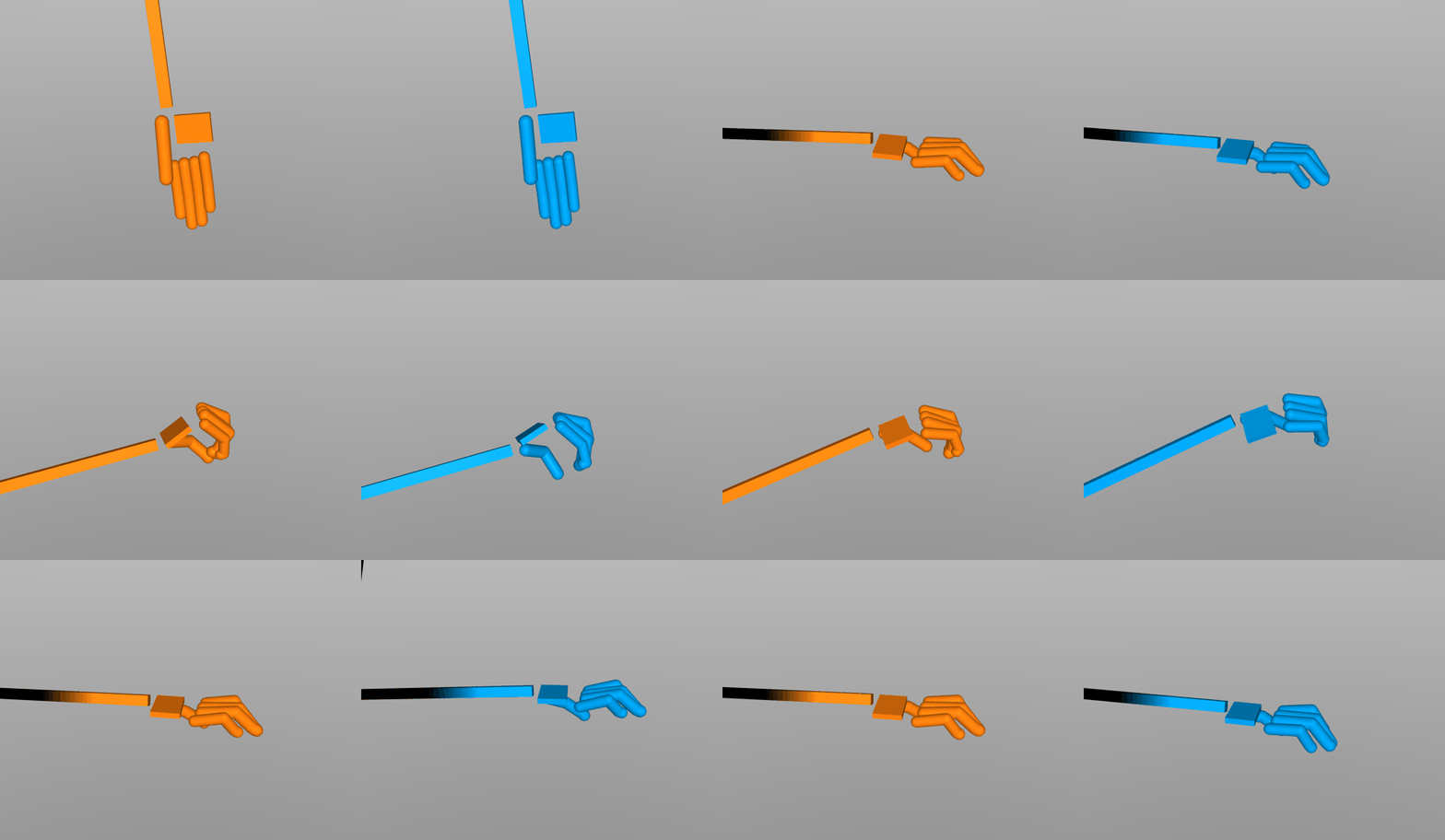
Key frames
Enlarge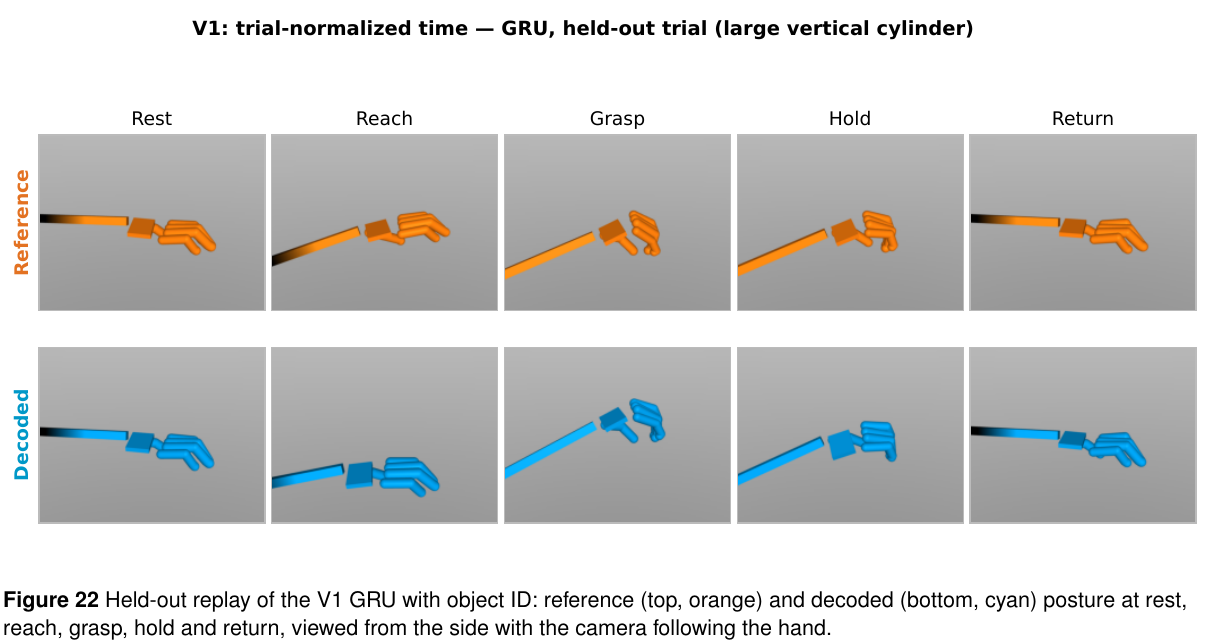
Offline MuJoCo reconstruction of cued movement, shown in motion and as key frames.